Sunday, June 11, 2017

June Zone Conference Summer Party


The Elders and Sisters talk about this particular zone conference for six months before....We all come to the mission home and spend two days with President & Sister Grant.  We had instruction and spirituality sharing, made plans and encouraged each other.


Everyone loved the visiting and comparing notes about their areas and its joys and challenges.


Fantastic food and in the evening games of basketball and volleyball.


Most senior missionaries sat on the balcony and enjoyed watching the evening volleyball game. President Grant, President Grahovoc and Sister's Ezard and Thompson were the only seniors who were brave enough to challenge the younger Elders & Sisters!


Veliki Tabor Castle

ARE YOU TIRED OF CASTLES YET???


June 6 P-Day.  Found us traveling again, this time to Veliki Tabor Castle, near the Slovenia border.
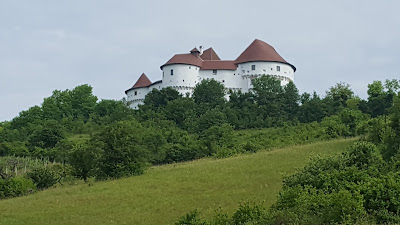

Veliki Tabor was built in the 1500's by Hermann II Celjsk, the father to the Prince's of Celje. I think there were four princes...

(Last weeks castle in Celje was this Hermann II's main castle.)


Veliki Tabor was later owned by a Hungarian noble family (Rattkay) for nearly two hundred years, until 1793, and then several other owners through the years.  Eventually it was taken over by the Republic of Croatia and has now been fantastically renovated.


They hold international festivals and archery contests here.


Legend of Veronika of Desinić...(Taken from medieval.com; which information was obtained from a well documented historical record)

Over centuries, many legends and stories arose of Veliki Tabor, particularly stories about ghosts that haunted it and strange groans on stormy nights. But the most legendary is the tale of Veronika of Desinic.


The legend begins a long time ago, when mighty count Hermann II of Celje ruled these parts.  They were a rich aristocratic family.
His younger son Frederick, riding once across his father's estate, met a beautiful young gold-haired woman by the name of Veronika. They fell in love at first sight, but the love was much disfavoured by the old count Hermann.  The disfavour was mostly due to the fact that Frederick was already married, but no longer living with his legitimate wife.  His father persisted on their reconciliation and arranged a meeting of the spouses in the city of Krapina. The next morning his wife was found in bed with a knife in her. Although the rumor was that Frederick himself had killed her, it was never proven.

After this event, Frederick and Veronika fled and were secretly married.  Count Hermann found out about the wedding soon though and sent an army to capture the lovers.  Frederick managed to get Veronika out of the town.  Unfortunately, Frederick was unable to escape his father's troops and was captured and locked in a tower in Celje (you saw that castle and tower last week on my post).  He spent over four years locked in the tower.


Veronika, had no better luck.  After a while, Hermann's soldiers found her and took her to Veliki Tabor.  He accused her of being a witch and a trial took place.  She was found innocent but he was furious and after the judges declared her free of charges and left, he ordered her to be killed.  The servants set a large wooden bowl of water in the middle of the castle, grabbed Veronika and drowned her.  Her dead body was sealed inside a wall.  Even today, especially during long winter nights, when wind blows, one can still hear the silent cries of poor Veronika!
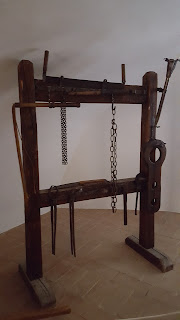


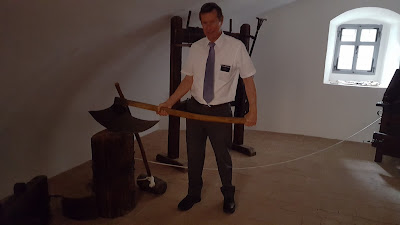
This castle even had a torture room, complete with "The Rack", a "Chair of Nails", "Chopping Block" and all kinds of weapons.  These people were not to be messed with or crossed!!


You can see why people fought/fight over this land...it is beautiful for miles and miles!


This picture is for my family who are farmers....Acres of crops:  grain, corn, potatoes, cabbage, carrots, peas, beans, tomatoes, onions, strawberries, cherries, apricots, grapes...NOT just gardens but acres.  They sell them at the different town squares throughout the countryside.


Neanderthal Museum

Near here, in Krapina, Croatia is an ancient excavation site, where bones of prehistoric people who lived in this area nearly 125,000 years ago were discovered in several caves along a small stream.

Neanderthal bones have been found around the world in different locations, which date their existence between 30,000 and 300,000 years ago.  In Krapina is a beautiful educational museum which chronicles through time, the theory of development.


The Elders were able to come along on this adventure with us.  Elder Frandsen and Elder Smith.


English Conversation Group


Twice a week we conduct an English speaking class for young Croatians.  Apparently they are given 4 years of German and 1 year of English in public school.


These are a couple of our brightest students and their mother is determined they are going to learn as much as they can while they are young. They pick it up a lot faster than any of the adults!

Saturday, June 3, 2017

Lipizzan Stud Farm

May 31st. A fun visit to the Lipizzan horse stud farm in Lipica, Slovenia. The foals are born black and turn white in five to seven years.
The Lipizzan is a breed that was developed especially by the Hapsburg monarchy to use during times of war and peace.  Four hundred years of selective breeding has made the Lipizzan one of Europe's oldest breeds.

The Spanish Riding School in Vienna has used the Lipizzan horses exclusively and owes its survival to the intervention of General George S. Patton during World War II where he retrieved the mares and returned them to Austrian soil.  (Watch the Disney movie, The Miracle of the White Stallions)

Chris especially enjoyed this visit and pestered the poor tour guide with never-ending questions about the care and breeding of the horses.  The best studs are housed in the finest stable, which was built in 1703.


Skocjanske Cave

May 31st found us east of Ljubljana, Slovenia visiting the Skocjanske cave.

Sadly we were not allowed to take pictures inside but it was absolutely huge.  Because most of Slovenia's bedrock is made up of limestone, it allows for lots of wonderful caves and formations within those caves.

Slovenia has 11,500 known caves and Skocjanske is the largest cave in the world, opening for tours in 1819.


Inside the cave are a total of 500 steps, leading up and down along beautiful maintained paths, criss crossing between stalagmites and stalactites.


There is a river running through part of the cave and at one point you cross over a bridge, which if you are brave enough to look over, you can see the grand canyon and river below!

Around each and every corner was another amazing and unbelievable sight.

City of Celje, Slovenia

May 30th.


We have now been to Celje, Slovenia a couple of times.  The trip this week was on our P-day so we were able to spend a little more time looking around the historic city, it's museums, palaces and castles.


Just down the street from the LDS Branch building, is one of the cities museums where recently discovered remains of Roman roads and buildings have been discovered just below the city streets.


Celje is a very old city and early records indicate it was incorporated into the Roman Empire in 15 BC.


The town was the seat of the Counts of Celje from 1342 to 1456.  Who owned more than 20 castles all over the territory of modern Slovenia and beyond through the marriages of their daughters.  


Several large hills or mountains tower above the city and resting upon one is the Celje Castle, built around 1125 AD.  It looks pretty impressive towering over the city on top of the high hill.
It has changed ownership many times through the centuries but currently is owned by the City of Celje and is currently being renovated.