
 We spent three days at Senior Conference, being instructed and uplifted by our mission president and office staff, and travel to and from the conference made up the rest of the trip (with a couple of over night stop overs along the way!) We had opportunity to visit several historical sites, which I will try to briefly share some information about. This is truly an amazing part of the world, one which you too can see if you come to visit or better yet, volunteer for a mission here!!!
We had so much fun sharing the gospel with all the hotel clerks, waiters, shop owners, and other tourists along the way. Growing up in Idaho and Utah, I don't think I've ever met anyone who had NEVER heard of the Mormon Church and here, hardly anyone has. It's great to be asked, what church do you belong too....and tell me more about it.
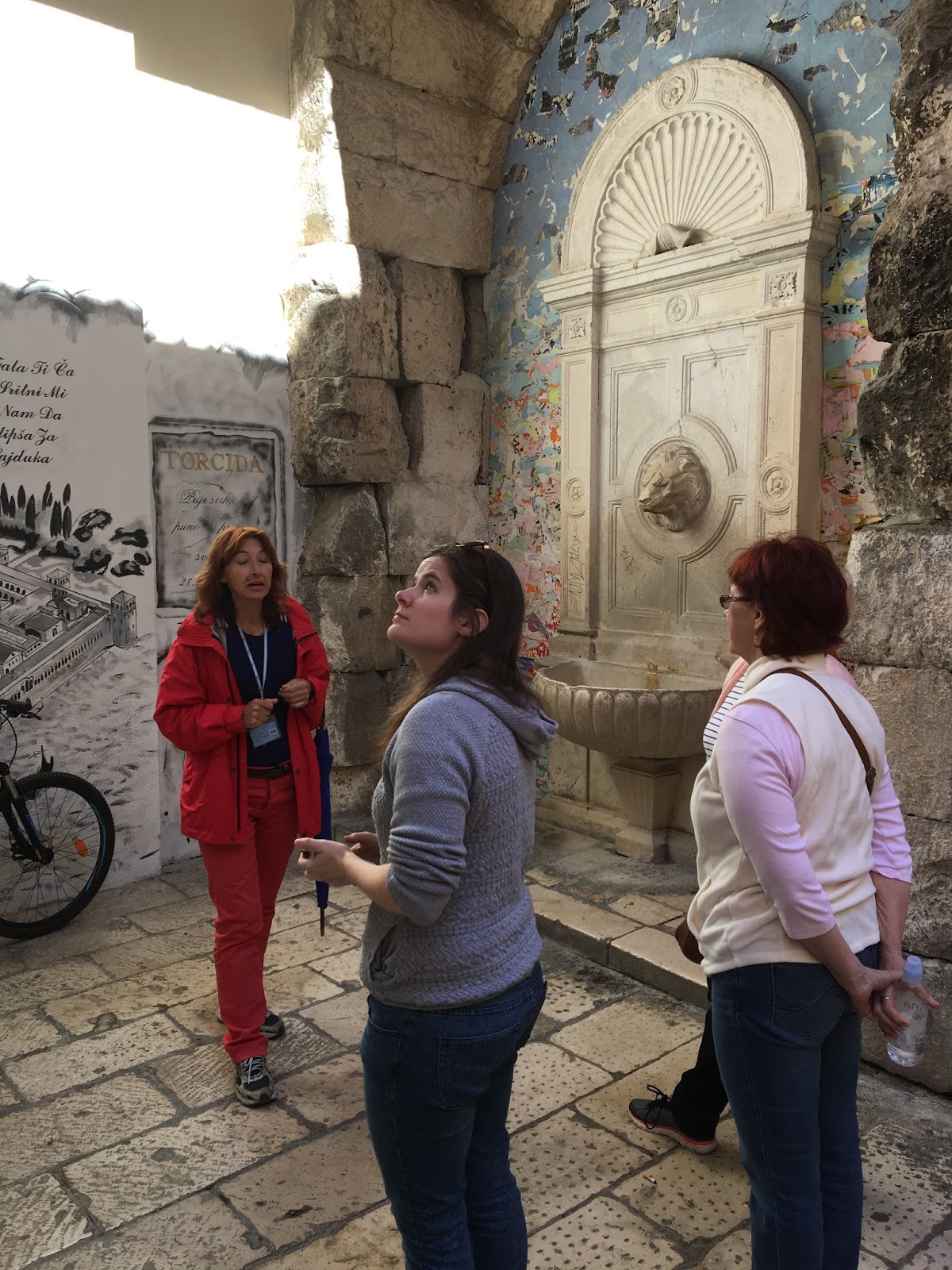
We traveled with our friends the Mayberry's, another senior couple, and they are great fun. One of our favorite experiences came the 2nd day of travel. We had stopped over night at Split, a city along the coast, and were taking a walking tour of the 616 AD Stone Palace. There were only the four of us and one single girl in the group. She had been born in Germany to a US military father and Germany mother. We walked around listening to the tour guide and of course talking a little to the girl.
After the tour ended we decided it was time to get some lunch and she asked if she might tag along. We stopped at a cafe within the Palace and began sharing with her. I asked if she had ever seen the elder's walking around with their white shirts and clean look. She said, she wasn't sure but maybe. We laughed a lot and talked about our church and why we were on a mission. At one point another missionary couple also traveling to our conference stopped at the table and began to converse with her as well. It was one happy loud group. She ended up spending the whole afternoon into the evening with us and we all shared facebook contact with each other. (She was on a tour of several countries by herself and staying in hostels. She had been bitten by bedbugs the night before, so Amanda, I shared my lavender oils with her and she was so grateful that it took the itch out of them. When we got back to our apartment, I I/M her how much fun it was to spend the day with her and hoped the rest of her trip went well. She sent back a request and here are her words:
"Had a wonderful time with you guys! I really like your energy. I've been thinking a lot about religion in general lately. I could tell how close you guys are. I've been feeling really lost on my trip, and I think I could use the kind of connection to God you all have cultivated. I was wondering (and I understand if you don't have the time, but I would seriously appreciate it) if you could give me an introduction of what your religion is all about?"
Wow! we were sooooo happy and excited. Sadly, we didn't see the message until it was too late to do anything about it that night and she left on an 8am tour the next morning. We have since contacted her and will be sending her information and the missionaries as soon as possible. It was a great start to the trip.
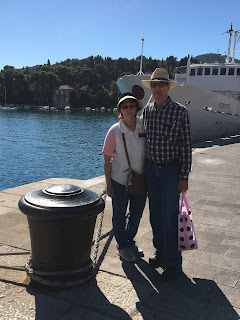
We took a ferry ride to Lupod, Island to visit one of the members from Osijek Branch, where the Mayberry's serve.

We took a ferry ride to Lupod, Island to visit one of the members from Osijek Branch, where the Mayberry's serve.


Visiting with Mirko was pure pleasure.
We learned that he was basically an orphan who the missionaries found at age 16 on the streets of Osijek and offered him the gospel. He eventually served a mission of his own in England and was working "at the sea" for the summer to earn enough money for college. He will be applying for the Church's Perpetual Education program.
He happily gave us a quick tour of his part of the quaint island, offering us free limes, lemons and pomegranates off the trees.
 Another missionary opportunity was in Kotor, Montenegro. We were spending a lot of time in one store trying to decide on whether to buy a hand carved Christmas Santa or not and became good friends with the clerk. We learned all about her history and where she went to school, and her religion. We shared that we were missionaries and she was so interested to know what we do. She asked a lot of questions and we told her where to find the Montenegro branch. We felt like she was a sweet new friend. Montenegro is the farthest east part of our Adriatic North Mission.
We ran into three or four different sets of people who yell..."Missionaries!!" They knew who we were and were so excited to find us in these odd places in the world. Two from Utah, One from Florida, one from Idaho. It's been a fun dream come true to have someone recognize your name tag when you are so far from home.
The family from Idaho were a young man and woman, with two small children and mom 6 months pregnant. They had been to Germany to visit their father who was ending his senior mission, and were bicycling across Italy and Croatia....we couldn't believe it...bicycling???? 6 months pregnant and riding with kids in bike car seats??? Were they crazy....we'll they were from Idaho! haha. I can say that can't I? They manage the outdoor theater in Driggs. Mons I think were their names.
Historical Information of the places we stopped:
 Split is a town
on Croatia’s Dalmatian Coast, and is known for its beaches and the fortress-like
complex at its center. The Diocletian's Palace, erected by the Roman emperor in the
4th century. It was once home to thousands, its sprawling remains include more than
200 buildings.
Split is a town
on Croatia’s Dalmatian Coast, and is known for its beaches and the fortress-like
complex at its center. The Diocletian's Palace, erected by the Roman emperor in the
4th century. It was once home to thousands, its sprawling remains include more than
200 buildings. 

Within its white stone walls and under its courtyards are a cathedral and numerous shops, bars, cafes, hotels and houses. The Palace is surrounded by tall ancient walls with four different gates, Bronze, Silver, Iron, and Gold. Only the Emperor was allowed to enter by the Gold Gate!
Dubrovnik:
Dubrovnik is a city in southern Croatia fronting the Adriatic Sea. It's known for its distinctive Old Town, encircled with massive stone walls completed in the 16th century. Its well-preserved buildings range from baroque St. Blaise Church to Renaissance Sponza Palace and Gothic Rector’s Palace, now a history museum.
Dubrovnik is a city in southern Croatia fronting the Adriatic Sea. It's known for its distinctive Old Town, encircled with massive stone walls completed in the 16th century. Its well-preserved buildings range from baroque St. Blaise Church to Renaissance Sponza Palace and Gothic Rector’s Palace, now a history museum.

Paved with limestone, the pedestrianized
Stradun (or Placa) is lined with shops and restaurants.


City dates back to the 13th century, although the walls were also constantly reinforced in later years. Dubrovnik old town is located within the city walls.


Lupod Island
Lopud is a small island 4.63 square kilometres off the coast of Dalmatia, southern Croatia. Lopud is economically the most developed of the Elaphiti Islands, and can be reached by boat from Dubrovnik.

Lopud is an island of true Adriatic summer feel, full of Mediterranean and subtropical vegetation, amazing cypress and pine parks and citrus gardens form the landscape of this magnificent island. It is no wonder then that in the time of the Dubrovnik Republic this island was a preferred spot of the patrician families to build a summer residence.
Throughout history Lopud has been known as an island of sea-captains providing the Dubrovnik Republic with many highly reputed seamen. In 16th century, Lopud had 30 churches, a vast number of Dubrovnik aristocracy summer manors, several monasteries and greater population. Today on Lopud you can see numerous remains of early-medieval churches, summer manors and fortifications.
Kotor, Montenegro

 The old town – that is the most famous part of Kotor, where the
Kotor history, culture, and tradition are being preserved. The old town of
Kotor has a great number of monuments of the medieval architecture: churches,
cathedrals, palaces, and museums. Its beauty is complemented with the multitude
of narrow streets, squares, and markets. The old town of Kotor stands out also
by the great number of stylishly made gates, palaces of the wealthy families,
and a great number of stairs.
The old town – that is the most famous part of Kotor, where the
Kotor history, culture, and tradition are being preserved. The old town of
Kotor has a great number of monuments of the medieval architecture: churches,
cathedrals, palaces, and museums. Its beauty is complemented with the multitude
of narrow streets, squares, and markets. The old town of Kotor stands out also
by the great number of stylishly made gates, palaces of the wealthy families,
and a great number of stairs.
The old nucleus of Kotor today is considered to
be the best preserved medieval urban entity in the Mediterranean. The largest
and the most impressive are, by all means, city bulwarks which surround the
town. They are about 5 km long, 20, high, and about 10 m wide. Bring completely
preserved, they are a unique sample of the fortification architecture in
Europe.
Island of Hvar
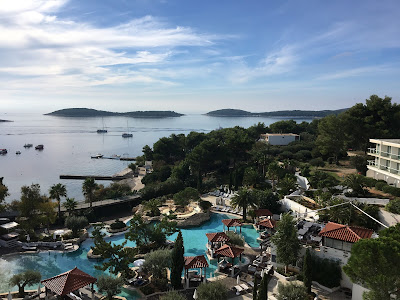
 Hvar, a Croatian island, is best known as a summer resort. Highlights of the port town
Hvar include its 13th-century walls, a hilltop fortress and a main square
anchored by the Renaissance-era Hvar Cathedral. The island also features
beaches such as Dubovica and inland lavender fields.
Hvar, a Croatian island, is best known as a summer resort. Highlights of the port town
Hvar include its 13th-century walls, a hilltop fortress and a main square
anchored by the Renaissance-era Hvar Cathedral. The island also features
beaches such as Dubovica and inland lavender fields.
The Franciscan monastery was founded in 1461. Within
the calm and silence of the
Monastery you can enjoy in monastery’s rich museum,
among which the collection of old masters is exceptional.

Plitvica Lakes
 The trip wouldn't be complete without a quick stop off at Plitvica lakes. In the summer time these paths around the lakes accommodate 15,000 people a day.
 Walking around the lakes
this time of year was beautiful.
 The leaves had changed and the colors most spectacular. (I must say, not near as beautiful as the mountains in Utah, but then I might be a bit prejudice!) Not crowded at all!
 The leaves had changed and the colors most spectacular. (I must say, not near as beautiful as the mountains in Utah, but then I might be a bit prejudice!) Not crowded at all!
 Plitviče Lakes National Park is a 295-sq.-km forest reserve in central Croatia. It's known for a chain of 16 terraced lakes, joined by waterfalls, that extend into a limestone canyon.
Walkways and hiking trails wind around and across the water, and an electric boat links the 12 upper and 4 lower lakes.


It was a beautiful fall day, spent with friends and enjoying the beauties of nature.


Chris took nearly 1000 digital photos over the days we were on this trip. It has taken me another two months to sort through them and to slim them down to a manageable size.
A fantastic Senior Conference and wonders of this part of the world, but the most
memorable sites will be the people we met and enjoyed along the way. Being a missionary
for the Church of Jesus Christ of Latterday Saints is the happiest time of the year!


